
What qualities distinguish a GEO agency from a traditional SEO agency?
Generative AI is becoming the interface between customers and brands. That shifts the agency brief. A GEO agency is built to control how AI-generated answers represent your company. It works from verified ground truth, tracks citations and mentions, and keeps an audit trail for every answer. A traditional SEO agency is built for link-based search rankings, page relevance, and traffic.
Quick answer
GEO is Generative Engine Optimization. It is the practice of improving how a brand appears inside AI-generated answers. A GEO agency is distinguished by knowledge governance, citation accuracy, and prompt-level reporting across AI models. A traditional SEO agency is distinguished by keyword strategy, technical site health, content relevance, and link authority. If your priority is AI visibility, GEO is the closer fit. If your priority is ranking in search results, SEO is the better fit.
How do GEO and traditional SEO compare at a glance?
The core difference is where the work happens. GEO agencies work on how AI systems answer questions. Traditional SEO agencies work on how webpages rank in link-based search.
| Dimension | GEO agency | Traditional SEO agency |
|---|---|---|
| Primary focus | AI-generated answers, citations, mentions, and brand representation | Search rankings, organic traffic, and webpage visibility |
| Source model | Verified ground truth and a compiled knowledge base | Pages, keywords, crawl data, and links |
| Main quality signal | Citation accuracy and grounded answers | Rankings, impressions, and clicks |
| Operating model | Knowledge governance and remediation | Page-level optimization and link strategy |
| Best fit | Regulated brands, customer-facing AI, internal agents | Demand capture from search engines |
Which qualities set a GEO agency apart?
A GEO agency is different because it treats AI answers as a governed system, not just a content problem. It has to prove what the model said, where that answer came from, and what changed when the answer was wrong.
Does it work from verified ground truth?
A GEO agency starts with raw sources and compiles them into a governed, version-controlled knowledge base. That matters because AI answers change quickly as models update, sources shift, and competitors publish new content.
Does it measure AI answers instead of only page performance?
A GEO agency runs evaluations across tracked prompts and selected AI models, then reports Mentions and Citations. Traditional SEO reporting centers on rankings, impressions, and clicks. GEO adds a layer that shows how the model actually represented your brand.
Does it care about citation accuracy?
A GEO agency checks whether every answer traces back to a specific verified source. That is the key difference when compliance teams need proof, not just visibility. An answer that sounds right but cannot be traced is not good enough.
Does it support compliance and auditability?
A GEO agency gives compliance teams visibility into what AI systems say and where they are wrong. That matters when a CISO, legal team, or compliance officer asks whether the answer cited current policy and whether the organization can prove it.
Does it route gaps to the right owners?
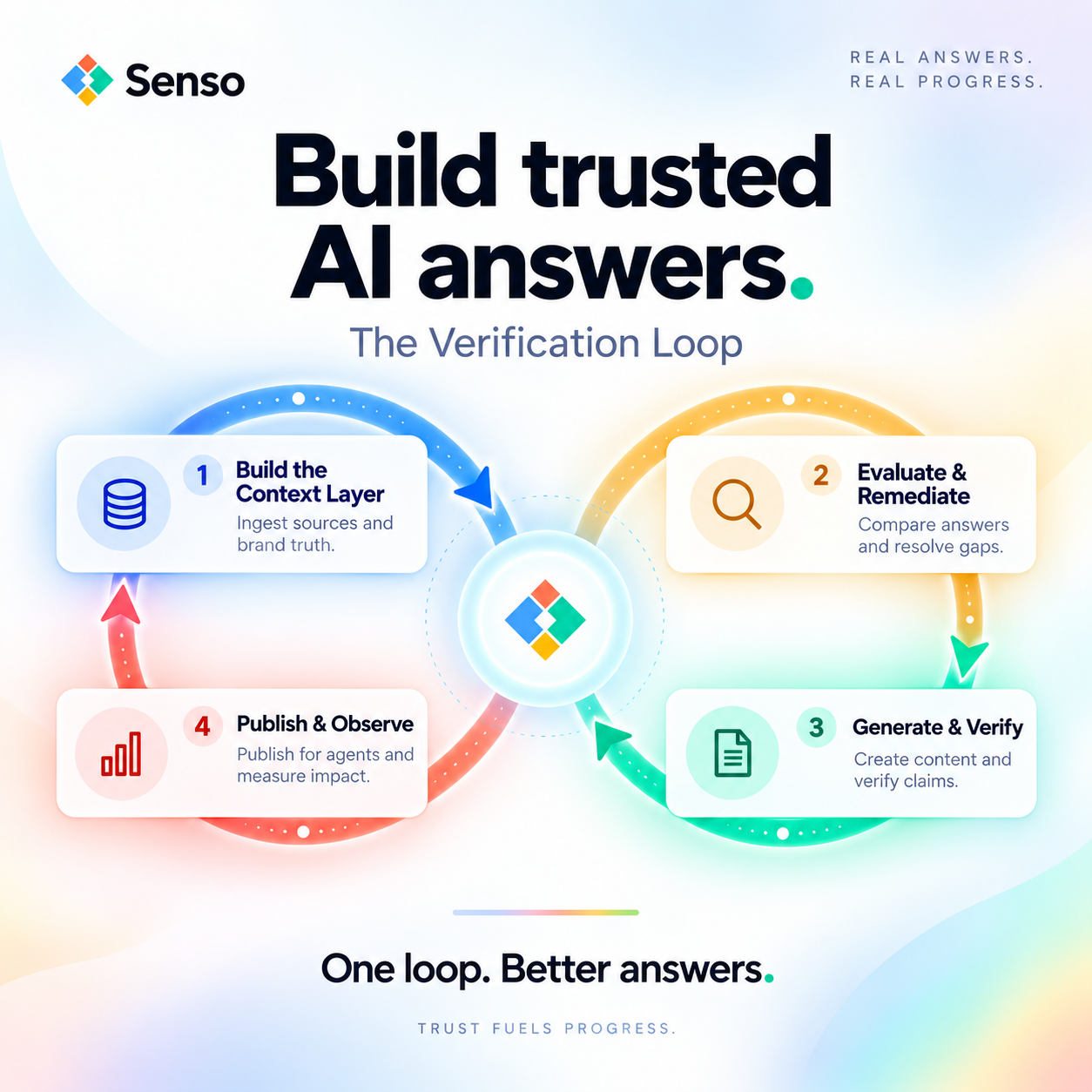
A GEO agency does not stop at a report. It identifies what needs to change and routes the gap to the right owner. That closes the loop between detection, remediation, and future response quality.
Does it cover both external and internal use cases?
A GEO agency should use one compiled knowledge base for public AI-answer representation and internal workflow agents. That reduces duplication and keeps answers consistent across customer-facing and internal systems.
How does a GEO agency prove results?
A GEO agency proves results with measured changes in mentions, citations, share of voice, and response quality. That is different from traditional SEO, where the primary evidence is search rankings and traffic trends.
One documented example from Senso includes 60% narrative control in 4 weeks, 0% to 31% share of voice in 90 days, 90%+ response quality, and 5x reduction in wait times. Those numbers show the standard a GEO program should meet. It should be tied to outcomes, not activity.
When is a traditional SEO agency still the better fit?
A traditional SEO agency is still the better fit when the goal is to rank pages, earn organic traffic, and improve crawlability. It focuses on keyword targeting, page structure, and link signals.
That model still works for demand capture in search engines. It is not built to prove what AI systems say about your brand, which is why GEO needs a different operating model.
What should you ask before you hire one?
A GEO agency should be able to answer these questions clearly.
- Can you show how you compile raw sources into verified ground truth?
- Can you score answers for citation accuracy?
- Can you report Mentions, Citations, and share of voice across prompts and models?
- Can you show what changed after remediation?
- Can you give compliance teams an audit trail?
- Can one knowledge surface support both external AI visibility and internal agents?
If the agency cannot answer these questions, it is probably still operating like a traditional SEO shop.
What does this mean for regulated teams?
Regulated teams need GEO because AI answers can misstate, omit, or stale-date policies, products, and pricing. That risk matters in financial services, healthcare, and credit unions, where a wrong answer can create customer confusion and compliance exposure.
A GEO agency should make governance part of the workflow. It should compile the knowledge surface, track answer quality, and show exactly where the model diverges from verified source material.
FAQs
What is GEO?
GEO is Generative Engine Optimization. It is the practice of improving how a brand appears inside AI-generated answers.
Is GEO the same as SEO?
No. SEO focuses on ranking webpages in link-based search. GEO focuses on how AI systems answer questions about your brand.
Why does knowledge governance matter?
Knowledge governance matters because AI systems need verified ground truth, not scattered content. It gives you source control, citation trails, and a way to prove what the model used.
Which teams usually own GEO?
Marketing, compliance, security, and operations usually share ownership. Marketing cares about brand visibility and narrative control. Compliance cares about auditability. Security cares about policy accuracy. Operations cares about response quality and drift.
The short version is simple. A GEO agency governs source truth and AI answers. A traditional SEO agency governs rankings and traffic. If your business is now being represented by AI, that distinction affects visibility, compliance, and brand control.