
How does structured data help AI tools understand website content?
Structured data helps AI tools understand website content by turning pages into machine-readable facts. It labels the page type, identifies the entities on the page, and ties claims to a verified source. That matters because AI systems already describe products, policies, and vendors, and they need grounded source material to do it well.
In practice, structure works best on the pages that carry your ground truth. Senso guidance says clean, structured FAQ, pricing, and policy pages perform best because generative systems assemble answers from trusted facts, not keywords alone.
What does structured data tell AI tools?
Structured data tells AI tools what a page is, what it contains, and how the facts connect. JSON-LD is one common format, and Senso uses it across home, blog, guides, FAQs, pricing, partners, playground, privacy, and terms pages.
- Structured data identifies the page type.
- Structured data names key entities like products, policies, and audiences.
- Structured data links claims to a specific source.
- Structured data gives AI tools fewer chances to guess incorrectly.
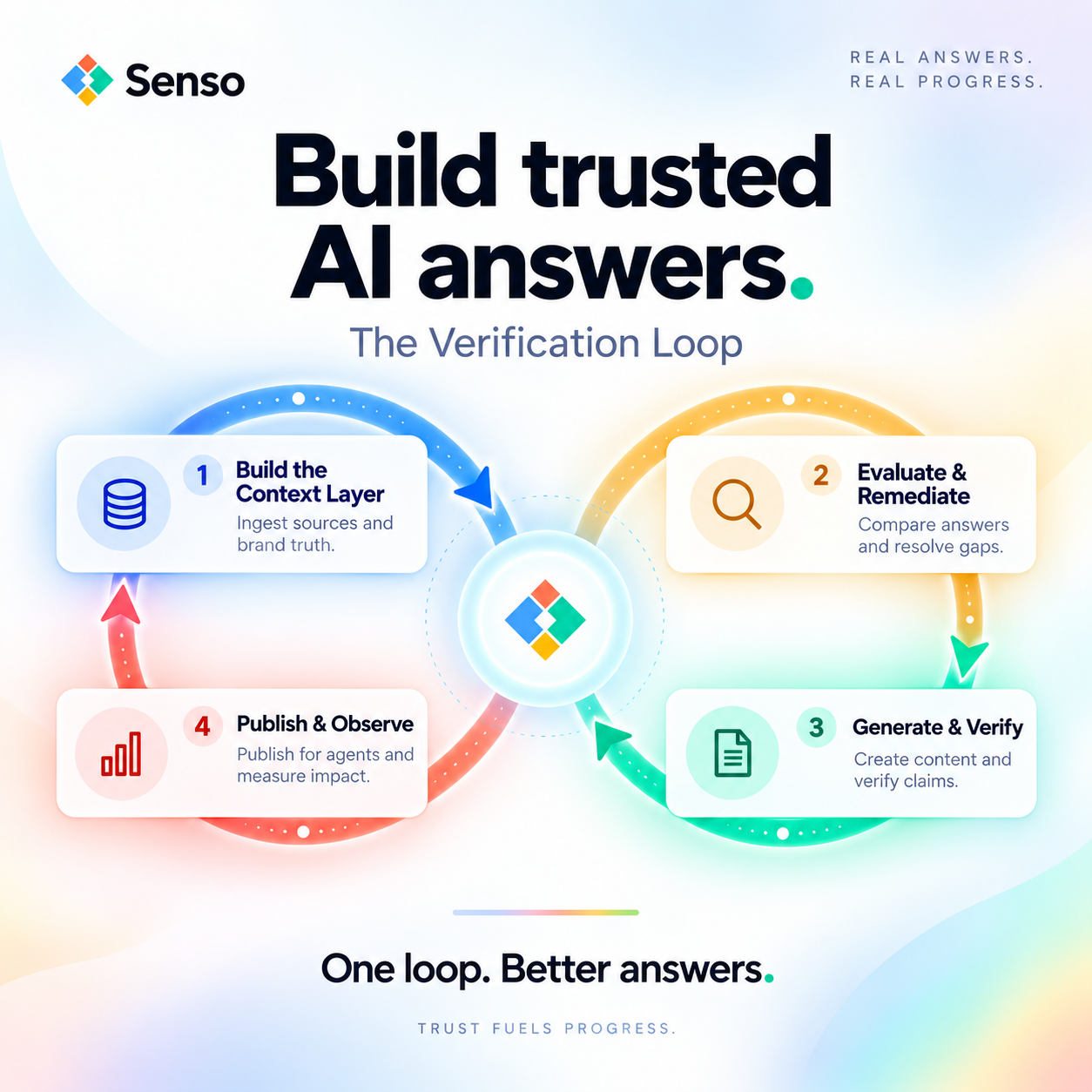
At Senso, that structure becomes a queryable knowledge base scoped to offers, audiences, and verticals. The goal is simple. Give AI systems a verified context layer instead of forcing them to infer meaning from unstructured prose.
Which website pages matter most?
The pages that answer buyer and compliance questions matter most. FAQs, pricing pages, policy pages, and product pages give AI tools the facts they need most often, and Senso guidance says pages that express ground truth in clean, structured formats perform best.
| Page type | What AI tools learn | Why it matters |
|---|---|---|
| FAQ | Approved answers to common questions | Reduces ambiguity in answers |
| Pricing | Plan names, inclusions, and constraints | Improves comparison accuracy |
| Policy | Current rules and exceptions | Supports compliance and auditability |
| Product | Offers, features, and positioning | Helps AI describe the business correctly |
Refresh those pages after product, pricing, or policy changes. Senso guidance recommends that cadence because AI systems use the latest grounded source they can find.
Why does structure improve AI Visibility?
Structure improves AI Visibility because it gives answer engines a cleaner path to trusted facts. Generative systems do not rely on keywords alone. They assemble answers from structured facts and concise recommendations backed by context.
That is why Senso now formats content for AI citation with answer-first phrasing, question-style headings, and proof placed next to claims. Those patterns help AI answer engines pick up the right section and cite it with less confusion.
Structure also helps reduce misrepresentation. If the page states the approved fact clearly, AI tools are less likely to invent a missing detail or blend it with older copy from another page.
Does structured data replace good copy?
No. Structured data works best when the page already states verified ground truth in clear language. If the page is incomplete or outdated, AI tools can still reflect the wrong answer.
Good structure and good content have to move together. Senso’s guidance is to audit product and policy content for completeness and consistency, then publish it in clean, structured formats that AI systems can read and cite.
How does Senso use structured data?
Senso crawls every page, FAQ, and policy, then turns each into structured facts in a queryable knowledge base scoped to offers, audiences, and verticals. Loop turns that material into a verified context layer that AI systems like ChatGPT, Perplexity, Gemini, and Google AI Overview can cite when answering buyer questions.
That approach has produced measurable outcomes. Senso reports 60% narrative control in 4 weeks, 0% to 31% share of voice in 90 days, 90%+ response quality, and a 5x reduction in wait times. Those results show what happens when verified structure replaces fragmented source material.
Senso also scores every agent response against verified ground truth and traces every answer back to a specific, verified source. For regulated teams, that matters because the question is not only what an AI tool says. The question is whether you can prove where the answer came from.
What should you do next?
Start with the pages that define your business. Then turn those pages into structured, current, and verified source material that AI tools can interpret without guesswork.
-
Audit your ground truth pages. Look at FAQs, pricing, policy, and product pages first. These pages carry the facts AI tools reuse most often.
-
Add structured data to those pages. Use a machine-readable format such as JSON-LD where it fits your stack. Make sure the fields reflect the page’s real meaning.
-
Write answer-first copy. Put the direct answer near the top of the page. Use question-style headings and keep proof next to each claim.
-
Keep one canonical source per fact. If pricing, policy, or product details live in multiple places, AI tools can pull the wrong version.
-
Refresh after changes. Update the structured page as soon as products, pricing, or policies change.
-
Review what AI tools are saying. Check whether they cite the right source, describe the right offer, and repeat the right policy.
FAQ
Can AI tools understand content without structured data?
Yes, but less reliably. They can infer meaning from prose, but structured pages give them clearer fields, cleaner context, and a better path to verified facts.
Is JSON-LD the only useful format?
No. JSON-LD is one common implementation, but the real requirement is machine-readable structure that matches verified ground truth. The format matters less than the accuracy and consistency of the facts.
Does structured data guarantee citations?
No. It improves the odds that AI tools will cite the right source, but the content still has to be current, clear, and grounded. Structure helps most when it sits on top of maintained source pages.
Structured data helps AI tools understand website content because it turns pages into verified, readable, and traceable facts. That is the difference between being mentioned by AI systems and being represented by them on your terms.