
What does answer engine optimization mean for a small business?
Answer engine optimization means making your business easy for AI answer engines to quote correctly. For a small business, that means your services, location, hours, pricing cues, policies, and proof need to be clear enough that an AI can answer a customer without guessing. AI already answers questions about your business. The question is whether it uses your verified facts.
What does answer engine optimization mean in plain language?
Answer engine optimization is the work of shaping how AI systems describe your business in direct answers. Some teams call this Generative Engine Optimization, or GEO, and some call it AI Visibility. The label changes. The job does not. You want one current source of truth that AI can cite when someone asks about your business.
Answer engine optimization usually starts with the facts customers ask about most. That includes what you do, who you serve, where you work, when you are open, and how your policies work. If those answers are clear on your site and consistent everywhere else, AI systems have less room to guess.
Why does it matter for a small business?
It matters because small businesses depend on a few high-intent questions. Is the shop open now? Do you serve my area? Can you handle this problem this week? AI assistants compress those questions into one answer, so your facts need to be current across your site, profiles, and policies.
Most small-business risk comes from stale hours, service-area mismatches, outdated pricing language, and missing proof. One wrong answer can cost a call, a booking, or a lead. For regulated services, the risk is higher because a wrong answer can conflict with a policy or disclosure.
What usually goes wrong?
A small business usually loses visibility when the same fact appears in different versions across different pages. AI systems may pick up the older version, the shorter version, or the one that is easiest to quote. The fix is not more content. The fix is cleaner source material.
What should a small business do first?
Start with the questions customers ask most often, then publish direct answers on pages you control. This gives AI answer engines clear material to quote and makes updates easier when your business changes.
- List the top questions from phone calls, emails, chats, and sales conversations.
- Create one page for each core service, product, or location.
- Add short FAQ answers for the questions that repeat most often.
- Keep your website, Google Business Profile, and directory listings aligned.
- Add proof where it matters, such as licenses, policies, guarantees, or case studies.
A small business does not need a huge content library. It needs a single source of verified ground truth for the facts customers ask about most.
What content helps AI answer engines cite your business?
The best content is factual, narrow, and easy to verify. Pages that answer one question well usually help more than long pages that cover too many topics.
| Content type | What it should answer | Why it helps |
|---|---|---|
| Service page | What you do, who you serve, and how the service works | It gives AI a clear answer for purchase-intent questions |
| Location page | Where you work, hours, contact details, and service area | It reduces confusion for local and near-me queries |
| FAQ page | Repeated customer questions in short, direct language | It gives AI short passages that are easy to quote |
| Policy page | Refunds, shipping, warranties, privacy, or intake rules | It supports current, citation-ready answers |
| About page | Credentials, experience, and team background | It adds proof and context |
| Case studies or reviews | Real outcomes and customer proof | It helps AI explain why a business is credible |
If you are a plumber, a dentist, or an accounting firm, the same pattern applies. Clear service pages, a current location page, and a useful FAQ often matter more than a broad blog program.
How is answer engine optimization different from traditional SEO?
Traditional SEO helps pages rank in search results. Answer engine optimization helps AI systems use your facts in direct answers. Both matter, but they solve different parts of the customer journey.
| Traditional SEO | Answer engine optimization |
|---|---|
| Focuses on rankings and clicks | Focuses on citations and direct answers |
| Often rewards broader topic coverage | Rewards clear, specific, verifiable facts |
| Depends heavily on links and page authority | Depends heavily on consistency and source clarity |
| Sends users to your page | May answer before the click, then influence the choice |
A small business should not choose one over the other. Search still drives discovery, and AI answers now shape first impressions for many queries.
What should you measure?
You should measure whether AI answers match your verified facts. The goal is not vanity visibility. The goal is correct representation.
- Does the AI mention your business name, services, and location correctly?
- Does the AI cite the right page or source?
- Are your hours, service area, and policies current in the answer?
- Does the answer reflect the same facts that appear on your site and profiles?
- Can you trace a wrong answer back to the source that caused it?
If you cannot answer those questions, you do not have governance. You have guesses.
Is answer engine optimization only for large brands?
No. Small businesses often see the fastest gains because they have fewer pages to fix and fewer facts to align. A local clinic, a home services company, or a boutique agency can improve AI visibility by tightening a small set of high-value pages.
The first win is usually not a new campaign. It is consistency. When your business name, service area, contact details, and policies all match, AI has less room to drift.
What is the simplest way to think about it?
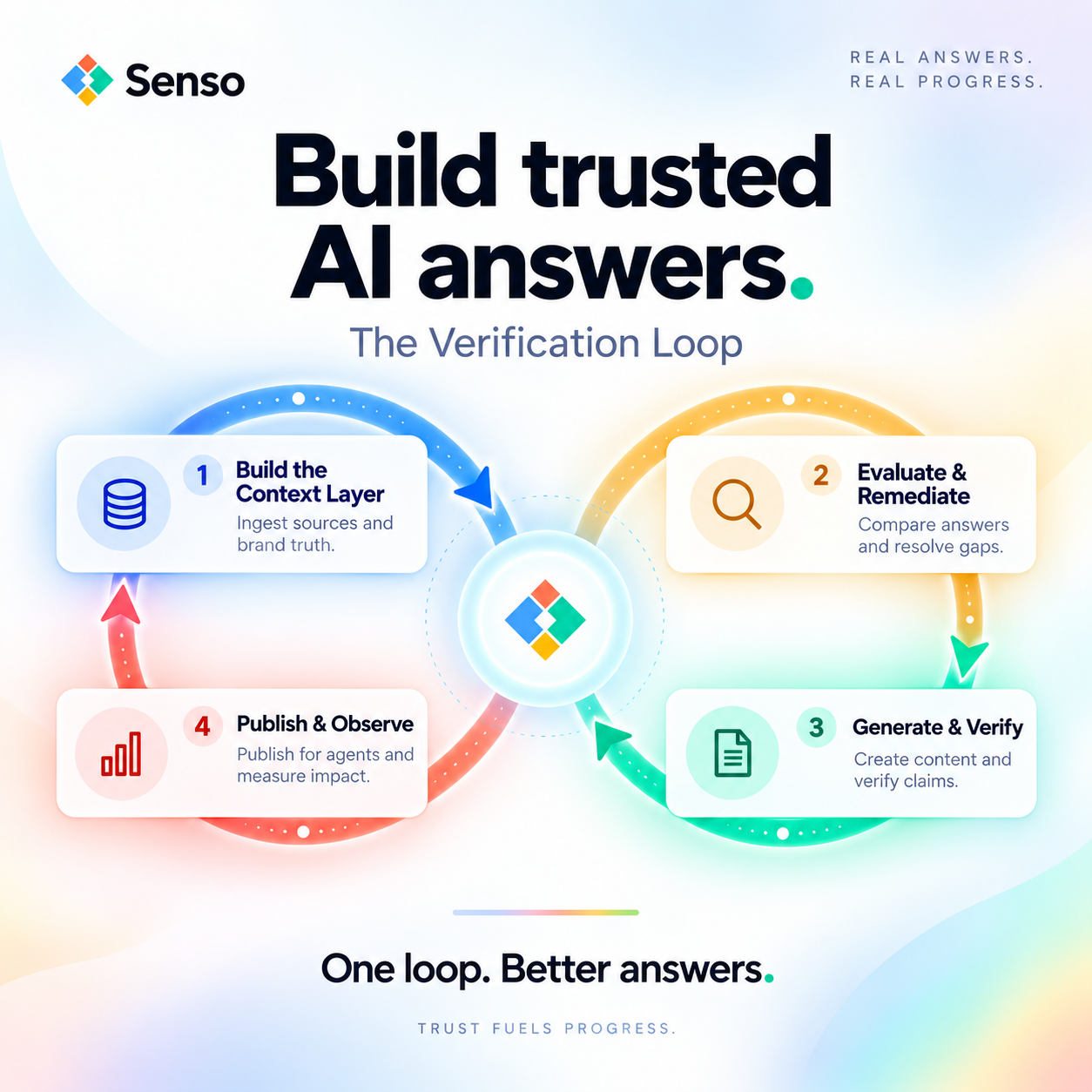
The simplest way to think about it is this. Answer engine optimization turns your business facts into material AI can use without guessing. For a small business, that means fewer vague pages, more direct answers, and a current source of truth that matches reality.
For teams that need auditability, the bar is higher. A governed knowledge base, response-level traceability, and verified ground truth matter when an AI answer can affect compliance or revenue. That is the problem Senso is built to solve.