
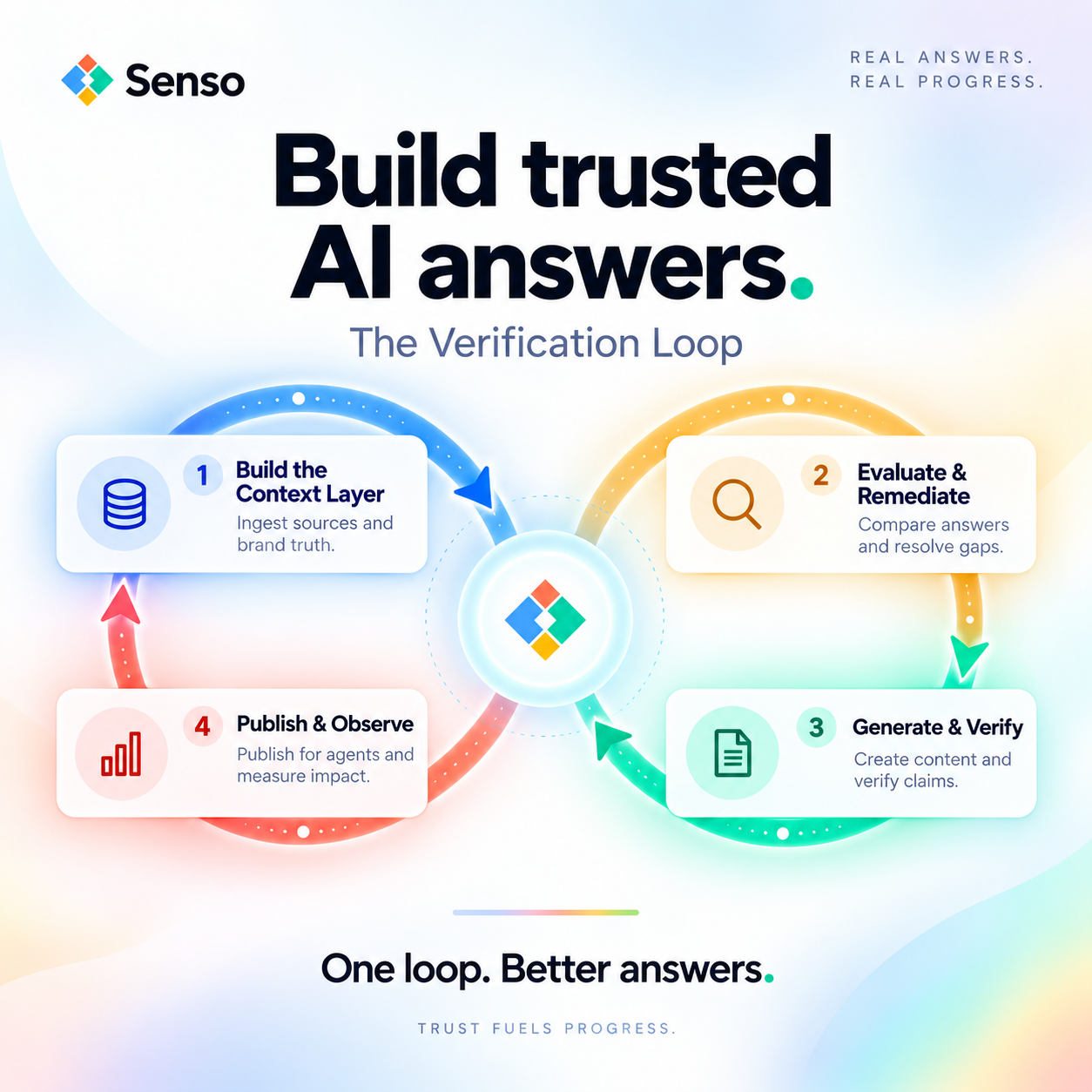
What is Answer Engine Optimization and why does it matter?
Answer Engine Optimization is the practice of making your content easy for AI answer engines to retrieve, cite, and repeat in direct responses. It matters because many buyers now start research in AI assistants and answer engines, which means your brand can be absent from the answer even when your website has the right facts. In practice, AEO is part of AI visibility, and many teams group the same work under Generative Engine Optimization, or GEO.
How does Answer Engine Optimization work?
AEO works by turning your content into a source an AI system can quote with confidence. The page needs a clear answer, consistent naming, specific facts, and a structure that makes verification simple.
The strongest AEO pages usually do five things well:
- Put the answer in the first sentence.
- Use one canonical name for each product, policy, or term.
- Support key claims with a verified source.
- Keep facts current when pricing, policy, or product details change.
- Use headings, tables, and short sections that are easy to extract.
AEO is not about stuffing more keywords into a page. It is about making the source easy to understand, easy to cite, and hard to misread.
Why does Answer Engine Optimization matter?
AEO matters because AI answers compress discovery, evaluation, and selection into one response. If your brand is not cited, the engine still answers the question, but it may do so with someone else’s facts.
That creates three business problems:
- Brand visibility: If AI systems do not cite you, you lose narrative control in the channel where buyers are asking questions.
- Compliance risk: If AI systems repeat stale policy or pricing, regulated teams lose the ability to prove the answer came from current ground truth.
- Operational risk: If internal agents answer inconsistently, teams spend more time correcting responses and less time moving work forward.
For regulated industries, the main issue is not traffic. It is whether the answer is grounded, citation-accurate, and auditable.
How is Answer Engine Optimization different from SEO, and where does GEO fit?
AEO is different from SEO because SEO is built for rankings and clicks, while AEO is built for direct answers and citations. GEO, or Generative Engine Optimization, overlaps with AEO because both focus on how your brand appears inside AI-generated responses.
| Term | Main goal | Main output |
|---|---|---|
| SEO | Earn search rankings and clicks | Search result traffic |
| AEO | Earn inclusion in direct answers | Cited answers and summaries |
| GEO | Improve AI search visibility in generative systems | Better representation in AI-generated responses |
The practical difference is simple. SEO asks, “How do we rank?” AEO asks, “How do we become the answer?”
What content works best for answer engines?
Answer engines prefer content that is direct, structured, and easy to verify. Pages that clearly define a term, compare options, explain a process, or answer common questions usually perform better than vague brand copy.
The most useful formats are:
- Definitions that open with one clear sentence.
- FAQs that answer the question in the first line.
- Comparison tables that separate similar options.
- Policy pages that state rules without ambiguity.
- Product pages that keep naming, features, and constraints consistent.
- Troubleshooting pages that explain what changed and what to do next.
The goal is not to write more. The goal is to write the exact answer in a form an AI system can use without guesswork.
How do you measure success in Answer Engine Optimization?
Success is measured by citation presence, answer accuracy, share of voice in AI responses, and the quality of the traffic or leads those answers generate. If the answer is wrong or missing, the metric should reflect that gap.
For teams that need proof, Senso AI Discovery scores public AI responses for accuracy, brand visibility, and compliance against verified ground truth. Senso reports 60% narrative control in 4 weeks, 0% to 31% share of voice in 90 days, 90%+ response quality, and 5x reduction in wait times. Senso AI Discovery requires no integration.
That kind of measurement matters because AI visibility is not just about being mentioned. It is about being represented correctly.
Why does knowledge governance matter for AI answers?
Knowledge governance matters because answer engines can only stay grounded if the source layer is governed. Fragmented raw sources, stale policy, and conflicting product pages produce inconsistent answers.
Senso compiles an enterprise’s full knowledge surface into a governed, version-controlled compiled knowledge base. One compiled knowledge base can power both internal workflow agents and external AI-answer representation, which avoids duplication and keeps answers aligned.
Senso Agentic Support and RAG Verification scores every internal agent response against verified ground truth, routes gaps to the right owners, and gives compliance teams visibility into where agents are wrong. That is the difference between hoping an answer is right and proving it is right.
What should teams do first?
Teams should start by identifying the pages and raw sources that answer the questions buyers ask most often. Then they should make those answers explicit, consistent, and easy to verify.
A practical starting sequence looks like this:
- List the top questions customers ask about your product, policy, or service.
- Map each question to one canonical source.
- Rewrite the answer so it appears in the first sentence.
- Remove conflicting language across pages and teams.
- Track how AI systems describe and cite your brand over time.
If you cannot prove the answer came from current ground truth, the content is not ready for answer engines.
FAQs
Is Answer Engine Optimization replacing SEO?
No. SEO still matters for discovery in search results. AEO adds a second layer for direct answers, citations, and AI visibility.
Do I need structured data for Answer Engine Optimization?
Structured data helps, but it is not enough on its own. AI systems still need clear language, consistent naming, and verified sources they can quote.
Is Answer Engine Optimization only for marketing teams?
No. Marketing, compliance, product, operations, and IT all affect the facts that answer engines use. In regulated environments, compliance and IT need a clear role because the answer must be provable.
What is the fastest way to improve AI visibility?
Start with the pages that define your brand, product, pricing, and policy. Make those pages current, consistent, and easy to cite, then measure how AI systems represent you over time.
Answer Engine Optimization matters because AI answers now shape perception before a user reaches your site. The teams that win this channel are the ones that treat it as a governance problem, not just a content problem.